

You live in São Paulo, Melbourne, Montreal, or Paris. You own a property in Lebanon, maybe a family home in the mountains, an apartment in Beirut, or a villa in the Beqaa, and you want to renovate it. But the thought of managing contractors from 10,000 kilometres away, with no reliable way to verify progress, protect your budget, or ensure the work matches your vision, is enough to keep the project permanently on hold.
This is one of the most common challenges we address at Dory Youness Interior Architecture and Design. Over the years, we have built a complete remote delivery methodology for Lebanese diaspora clients, and the results consistently surprise people who expected the experience to be stressful. This guide explains exactly how it works, and what you need to have in place to protect yourself.
Why Most Diaspora Renovations Go Wrong
The failure mode for a Lebanese diaspora home renovation is almost always the same: the client relies on a local relative or friend to keep an eye on things, engages a contractor without a formal design and documentation package, and pays in instalments based on verbal progress reports. Six months later, the budget is 40% over, the finishes are not what was agreed, and there is no paper trail to enforce accountability.
This is not a reflection of dishonesty, it is a reflection of the absence of structure. Without proper documentation, supervision, and milestone-based payment protocols, renovation projects in any country trend toward cost overruns and quality deviations. In Lebanon, where building regulations are inconsistently enforced and contractor relationships are often informal, the risk is amplified.
"The single most important thing a diaspora client can do is separate the design authority from the contractor. Your architect must be your advocate on the ground, not the contractor's business partner."
The Remote Delivery Framework That Works
Step 1: Establish a Full Design Package Before Engaging Any Contractor
This is non-negotiable. Your interior architect should produce a complete design package, 2D technical drawings, 3D Digital Twin visualization, material specification sheets, and a full BOQ, before any contractor is approached. This package becomes the basis for contractor tendering, agreement, and accountability.
When a contractor knows they will be measured against a specific, documented standard, not a vague description, they price accurately and perform accordingly. More importantly, if they deviate from the specifications, the deviation is documentable and contractually actionable.
Step 2: Use the Digital Twin for Design Approval from Abroad
The Digital Twin is a hyper-realistic 3D model of your space that shows every finish, fixture, lighting scheme, and spatial arrangement exactly as it will appear when complete. As a diaspora client, this is how you exercise genuine design authority from abroad.
Rather than approving a floor plan you cannot fully visualise, you walk through your future space in 3D, adjusting the marble veining on the kitchen island, the warmth of the lighting in the master bedroom, the layout of the living area. All of this happens before construction begins, at a fraction of the cost of mid-construction changes.
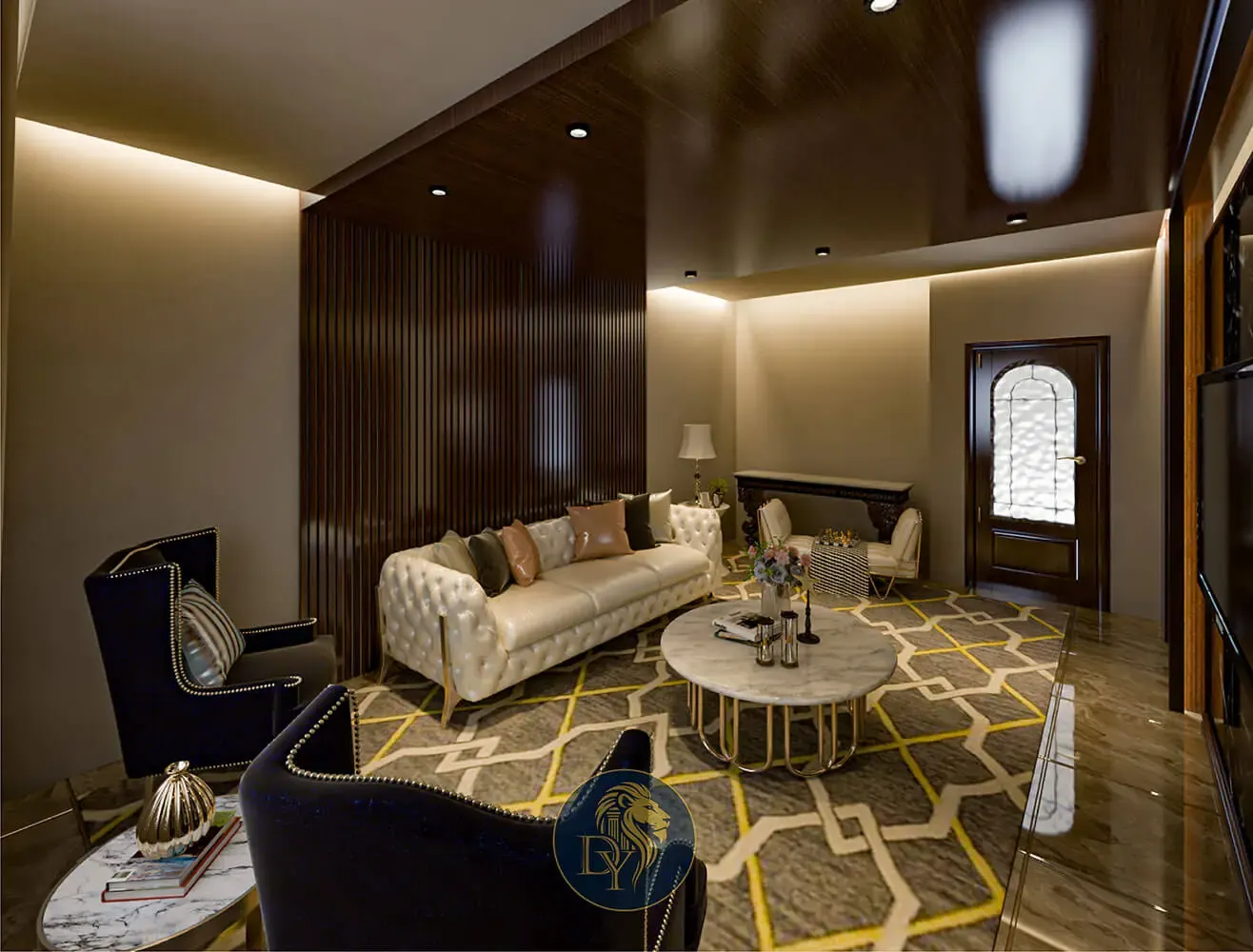
Villa Zahle living area, designed, approved, and executed with the client based abroad throughout the project.
Step 3: Milestone-Based Payment and Site Supervision
A structured remote delivery project uses milestone-based payments: specific percentages released only when defined site conditions are verified and documented. Common milestones include: demolition complete and verified, rough MEP installed and inspected, flooring complete, millwork installation complete, finishing and snagging complete.
Your architect or a designated project manager attends each milestone inspection, documents the site with photographs and video, and signs off before funds are released. This keeps contractors accountable and gives you real-time visibility from abroad.
Step 4: WhatsApp Progress Updates on a Fixed Schedule
Technology has made remote project management dramatically more effective. A weekly video call with the project manager, a fixed weekly photo update, and a WhatsApp channel for day-to-day communication means diaspora clients are genuinely informed rather than anxiously waiting for sporadic news.
The psychological benefit of this structure should not be underestimated. Clients who feel well-informed make better decisions, respond faster to issues that require input, and experience significantly less stress throughout the project.

Mayfair Sanctuary entrance, every finish selected and approved remotely by the client.
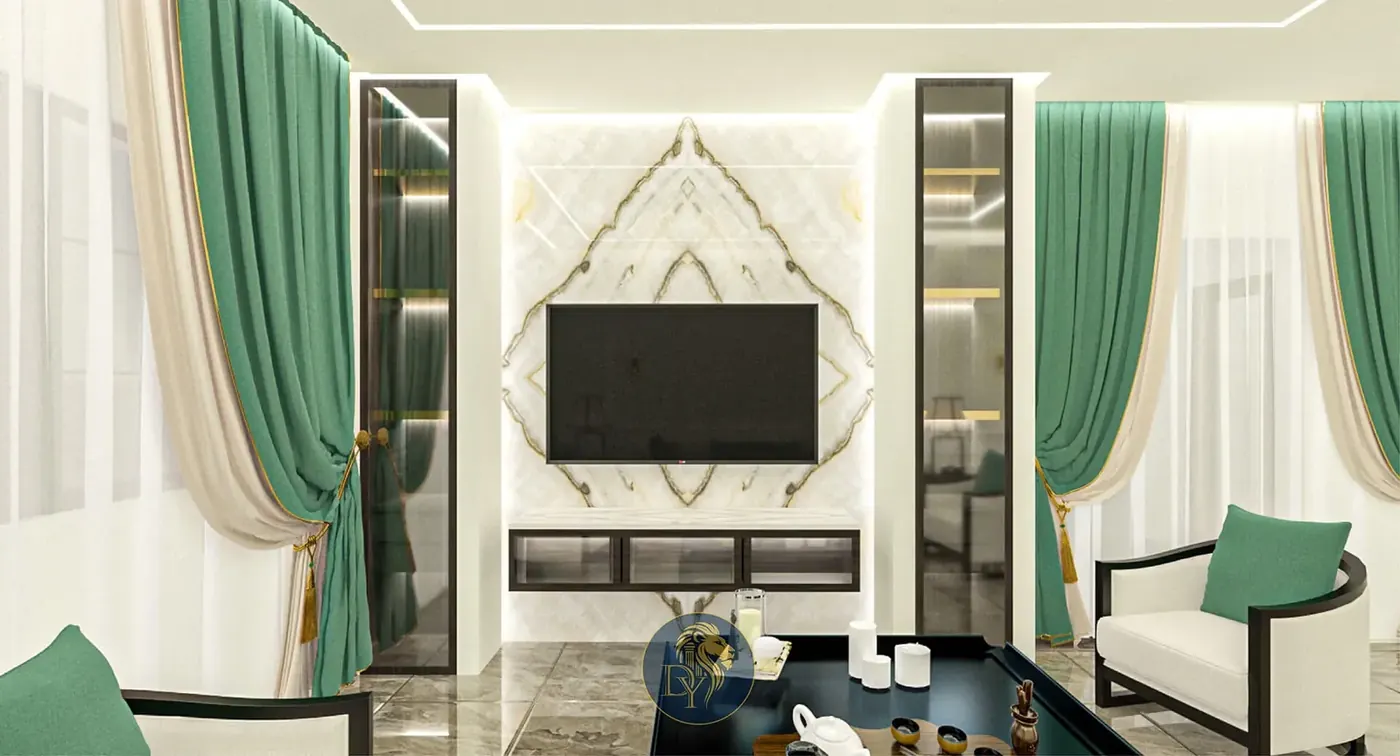
Custom millwork TV wall, specified in the BOQ, executed to exact specification.
Questions Every Diaspora Client Should Ask Before Starting
- Does the firm have experience with remote clients specifically? Managing a diaspora project is a different discipline from managing a project where the client can visit the site freely. Ask for specific examples.
- Is there a dedicated site supervisor? Not the designer visiting occasionally, a qualified professional whose primary role is site supervision and documentation.
- How are design approvals handled remotely? Look for firms that use Digital Twin methodology, not just PDF presentations.
- What is the payment milestone structure? Every phase should have defined deliverables that trigger payment. Avoid firms that ask for large lump-sum payments in advance.
- What happens if there is a dispute with a contractor? Your architect should have a documented process and the contractual authority to enforce design specifications.
Managing the Financial Side from Abroad
Currency management is a real consideration for diaspora clients renovating in Lebanon. The country operates in a dual-currency environment, and material prices for imported goods are typically quoted in USD. Your BOQ should clearly specify which line items are priced in USD and which in LBP, and what exchange rate assumptions are built into the budget.
A well-structured BOQ also allows you to phase the project, beginning with the structural and MEP work, for instance, and completing finishes in a second phase once the first phase is confirmed and settled. This gives diaspora clients flexibility to manage the investment according to their own financial timeline.
Dory Youness Interior Architecture has a dedicated remote delivery methodology for Lebanese diaspora clients in Brazil, Australia, Canada, France, USA, UK, and Argentina. Message us to discuss your project, we reply within 24 hours.
WhatsApp for Diaspora Enquiries Renovate in Lebanon from Abroad →Country-Specific Considerations for Diaspora Clients
The Lebanese diaspora is geographically dispersed across five continents, and the practical reality of managing a Lebanon renovation differs meaningfully by country of residence. Understanding these differences helps diaspora clients plan their engagement more precisely.
For Lebanese in Brazil, the largest diaspora community outside Lebanon itself, the time difference with Beirut is five to six hours, which allows for early-morning video calls before the Beirut working day ends. Portuguese-language briefings are available for Brazilian-Lebanese clients who prefer to conduct design discussions in their primary working language. The distance makes the Digital Twin workflow particularly important: Brazilian-based clients cannot make quick trips to review material samples and typically need the full three-dimensional model to confidently approve design decisions from 11,000 kilometres away.
For Lebanese in Australia, the time difference, eight to eleven hours ahead of Beirut, depending on season, makes real-time communication more logistically demanding. Our Australian-based clients typically schedule their weekly project reviews as late-afternoon calls in Beirut, which corresponds to early evening in Sydney or Melbourne. All critical decisions are documented in writing immediately after each call so there is no ambiguity about what was agreed when the design team returns to the site the following morning.
For Lebanese in France, particularly the large community in Paris and Lyon, the one-hour time difference from Beirut makes communication almost seamless. French-language design reviews are available for French-based clients. France-based Lebanese clients also benefit from being close enough to visit Lebanon for the design sign-off milestone without major logistical disruption, which we encourage as the single most valuable investment of physical presence during the whole project.
For Lebanese in Canada and the USA, the six-to-nine-hour time difference from Beirut creates a practical morning-call window: 8am in Toronto or Montreal corresponds to 2pm or 3pm in Beirut, within the working day in both cities. North American-based Lebanese clients often find that the project management discipline required for remote renovation, documented decisions, structured approvals, BOQ-based financial reporting, aligns closely with the project governance standards they are accustomed to in professional environments in Canada and the United States.
Frequently Asked Questions: Diaspora Renovation in Lebanon
Do I need to visit Lebanon at all during my renovation? Ideally once, at the design sign-off stage, to physically review key material samples before they are committed to fabrication. Stone slabs must be seen in person: the depth, veining, and surface character of natural stone are qualities that no photograph or screen fully conveys. If a physical visit is truly impossible, we can arrange for curated material samples to be shipped to your location for review. Beyond that single milestone, a properly structured remote delivery engagement does not require physical presence during construction.
How do I transfer money to Lebanon safely for a renovation project? This is among the most important practical questions for diaspora clients, and the answer has changed significantly since the banking crisis of 2019. We work exclusively with payment structures that do not route funds through the Lebanese banking system in a way that exposes client capital to conversion or withdrawal restrictions. Contractor and supplier payments are structured using fresh dollar arrangements, cash or transfer, against the BOQ-verified scope at each construction milestone. Your design and management fees are paid outside Lebanon in whichever currency and banking system is most convenient for your country of residence. We can provide a detailed payment framework at the outset of any engagement so there are no surprises about how funds move through the project.
What if something goes wrong during construction while I am abroad? This is precisely why the BOQ and site supervision structures exist. When a contractor deviates from the agreed specification, wrong material, incorrect dimension, unapproved substitution, a supervisor with photographic documentation and a complete BOQ can raise a formal non-conformance notice that requires remediation before payment of that trade's next milestone. Without these structures, a diaspora client's only recourse when discovering a construction defect is a difficult conversation after the fact. With them, problems are caught at the moment they occur and corrected before they become embedded in the finished space.
One Visit Is Ideal, But Not Required
Ideally, a diaspora client visits Lebanon once during the project, typically at the design sign-off stage, before construction begins, to confirm selections in person and walk the Digital Twin with the team on-site. But with a properly structured remote delivery methodology, even this is optional. We have completed full projects without the client ever setting foot on-site during construction, delivering results that meet and exceed expectation.
What makes the difference is not physical presence, it is documentary precision and a firm you can trust completely to act in your interest at every stage.
Your Lebanese Property Is Worth Protecting
Lebanese property, for diaspora families, is often more than an investment, it is heritage, memory, and a connection to home. Renovating it well is an act of care, not just capital allocation. Done right, with the correct team and methodology, it can be completed without stress, without surprises, and with a result that will be enjoyed for generations.
If you are a Lebanese diaspora client considering a renovation, we invite you to reach out. We will take the time to understand your project, your timeline, and your concerns, and explain exactly how we would structure the work to protect your interests from start to finish.