
Beirut is a city that has always known how to be beautiful under pressure. Its interior design scene reflects this paradox: some of the most sophisticated residential spaces in the Middle East exist here, crafted by architects who understand both the technical demands of luxury execution and the cultural sensibility required to make a Beirut interior feel definitively, irreducibly Lebanese.
This article explores what distinguishes a truly luxury interior architect in Beirut from the broader market, what clients should look for when selecting a design partner, and what the best work in the city looks like in 2026. The answers are more specific, and more demanding, than most clients initially expect.
The Beirut Design Aesthetic: Luxury Without Uniformity
Unlike Dubai, where luxury interior design tends toward a shared international vocabulary of stone, gold leaf, and dramatic scale, Beirut's luxury design scene is defined by diversity. Neoclassical salons in Ashrafieh that reference the finest Haussmann apartments of Paris. Rigorous modernist apartments in Verdun with Japanese spatial influence. Mediterranean-contemporary villas in the mountains that feel entirely and specifically their own.
What unifies the best work across these different aesthetic registers is not a style. It is a standard: exceptional material quality, rigorous technical execution, and a spatial intelligence that makes every room feel considered from every angle, in every light condition, and at every moment of the day. That standard does not announce itself. It is simply present, in the way a space feels inevitable rather than assembled.
"In Beirut, luxury is not about excess. It is about precision, restraint, and the confidence to let materials speak without being outcompeted by decoration."
What Beirut's Best Interior Architects Have in Common
The firms that consistently produce the best luxury work in Beirut share three technical characteristics. First, they produce genuine technical documentation: full 2D construction drawings, coordinated reflected ceiling plans, detailed joinery drawings, MEP coordination diagrams, and a complete Bill of Quantities. These are the documents contractors actually build from, not presentations. Without them, construction is guided by approximation and the contractor's own interpretation.
Second, the best firms maintain supplier relationships giving access to materials unavailable to general contractors: specific marble blocks from named quarries, custom hardware from European manufacturers, fabric from specialist ateliers, handmade tile from artisan producers. Third, they have genuine site supervision capacity, structured weekly reporting, photographic documentation at every construction milestone, and contractor accountability management that holds work to the agreed specification.
How Lebanon's Situation Has Reshaped the Luxury Market
The economic crisis, the port explosion of 2020, and the ongoing instability have profoundly reshaped Beirut's luxury interior market. The client base has shifted significantly. Many of the highest-budget projects now come from diaspora owners renovating or restoring properties they inherited or acquired, from families who preserved their wealth through dollar-denominated assets outside the Lebanese banking system, and from GCC-based Lebanese professionals returning to invest in Beirut property.
For interior architects, this shift has transformed how services are delivered. Remote-client delivery, where the client approves all design decisions from abroad without ever being physically present in Beirut during construction, has become a primary service model rather than an exceptional arrangement. This has simultaneously accelerated the adoption of Digital Twin technology, which allows diaspora clients to walk through their future spaces in three dimensions and exercise full design authority from thousands of kilometres away.
Material Choices That Define Beirut Luxury
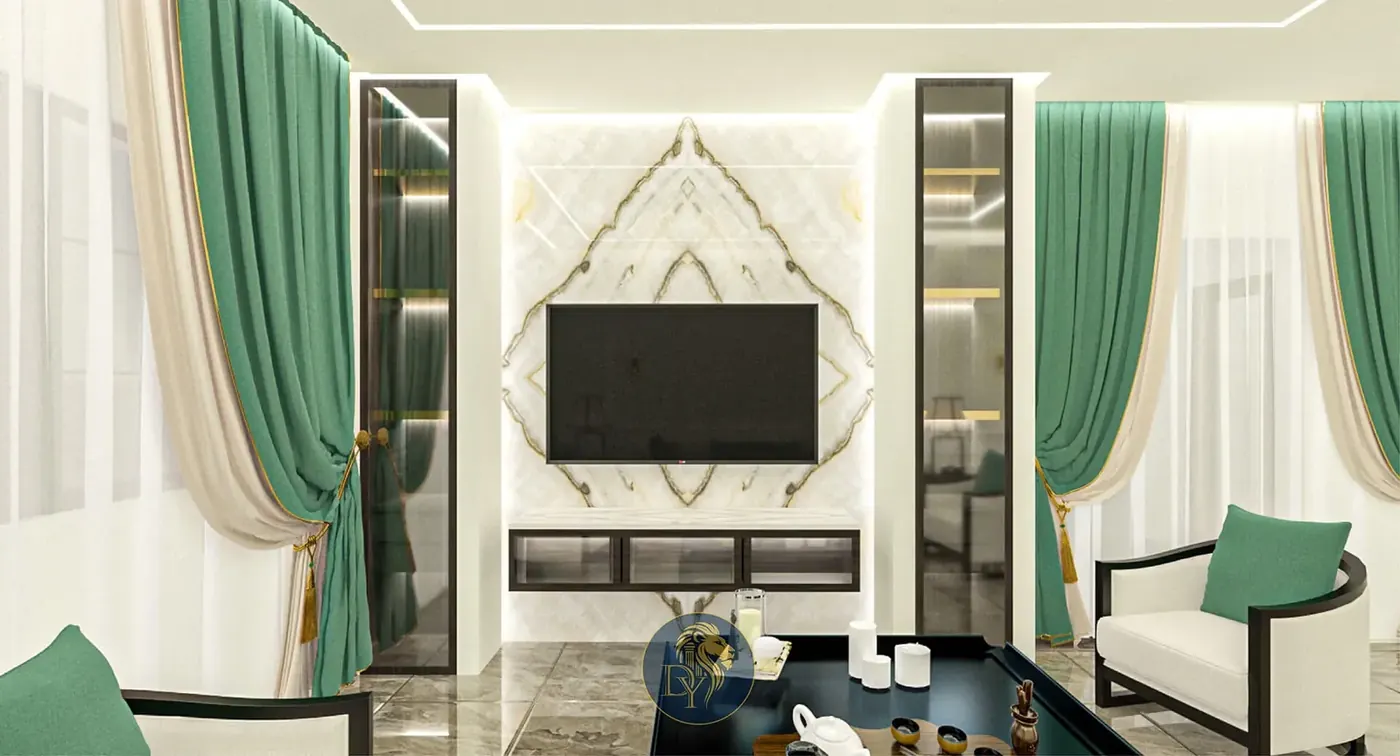
The material palette of Beirut luxury interiors has a distinctive character that reflects the city's own hybrid identity. Italian and Spanish marble, particularly the Calacatta and Statuario families, with their strong veining and depth of surface, remains the defining material for statement walls, feature floors, and bathroom cladding. Lebanese walnut, one of the most architecturally beautiful cabinet-grade timbers available anywhere in the region, is used extensively for joinery across residential and commercial projects.
In terms of metal finishes, brushed bronze and aged brass have largely replaced the heavy, high-polish gold that defined an earlier era of Lebanese luxury interior design. These warmer, more nuanced finishes read as sophisticated rather than opulent, reflecting a genuine maturation of Lebanese client taste. What distinguishes Beirut's finest work is the confidence with which these materials are handled: marble panels planned from the quarry face, joinery designed to millimetre precision, lighting architecture integrated into structure rather than added as afterthought.
Common Mistakes Clients Make When Hiring a Luxury Interior Designer in Beirut
The most expensive mistake in Beirut's luxury market is not overspending on materials. It is under-specifying the design documentation and then overpaying during construction to recover from the ambiguity. When a contractor has no BOQ to work against, no joinery drawings to build from, and no reflected ceiling plan to coordinate mechanical and lighting positions, they fill the gaps with their own judgment. That judgment rarely matches what the client imagined. The result is a expensive space that does not quite work, marble joins that do not align, lighting positions that compete with furniture, storage quantities that are inadequate because they were never calculated against the actual wardrobe contents they need to hold.
A second common mistake is selecting a designer based primarily on portfolio aesthetics without verifying the technical and project management capacity behind the work. Beautiful renderings are necessary but not sufficient. The question to ask is not "Do I like your projects?" but "Walk me through how you managed the last difficult site situation you encountered." The answer tells you everything about how the firm operates under real conditions, and in Beirut in 2026, every project encounters real conditions.
Third, many clients resist the proper design timeline in an effort to reach construction quickly. On a luxury apartment in Beirut, a thorough design phase takes eight to fourteen weeks. Cutting it to three or four weeks to accelerate the schedule almost always extends total project duration, because questions left unanswered in design are answered, more expensively, during construction.
Frequently Asked Questions: Luxury Interior Design in Beirut
How much does luxury interior design cost in Beirut? Design fees for a full-service luxury engagement, covering concept design, BOQ preparation, 3D Digital Twin visualisation, full construction drawing set, and site supervision, typically range between 8% and 15% of construction cost, depending on project complexity. On a 200 sqm apartment with a $300,000 construction budget, expect design and management fees of $25,000–$45,000. This is not an overhead: it is the primary cost-control mechanism. Projects without proper documentation consistently overspend their construction budgets.
Can a luxury interior designer in Beirut manage my project remotely if I live abroad? Yes, provided the firm has genuine remote delivery infrastructure. This means a structured Digital Twin workflow that allows you to review design decisions in three dimensions without travelling, a site supervision protocol with weekly photo and video documentation, and a financial reporting system that tracks contractor payments and material procurement against the agreed BOQ. Firms that say they can do remote management but deliver it by WhatsApp message and occasional video calls are not delivering the same service. The distinction is infrastructure, not intention.
How long does a luxury apartment renovation take in Beirut? For a full-scope 200 sqm apartment, design, permitting where required, and construction, expect 12 to 18 months from brief to handover when managed properly. Compressed timelines exist but they come with costs: reduced design thoroughness, reduced material lead times meaning fewer choices, and reduced site supervision density. The projects that deliver in 8 months tend to reveal their compromises two years later. The projects that take 14 months and are done properly continue to reward the patience indefinitely.
What is the difference between a Beirut interior architect and an interior decorator? An interior architect produces the complete technical documentation required to build: structural intervention drawings, MEP coordination, joinery construction drawings, material specifications to contractor grade, and a BOQ that enables genuine contractor tendering. An interior decorator selects finishes, furniture, and accessories and assembles them in a space that already exists. Both have value. For any project involving construction, structural changes, built-in joinery, or systems coordination, you need an interior architect. For furnished apartments and styling work, a decorator may be appropriate. When in doubt, the presence or absence of a BOQ is the reliable indicator of which service you are actually receiving.
Working With a Luxury Interior Designer in Beirut
A full-service luxury engagement in Beirut begins with a structured design brief session, typically two to three hours, covering how you use your space across different times of day, which aesthetic references resonate and which do not, what functional requirements the space must meet, and what the investment ceiling is. This is intelligence gathering. A professional architect should ask more than they tell in that first session.
From that brief, the design phase proceeds through concept development, Digital Twin visualisation, material selection boards with actual samples, and complete BOQ documentation. On a 200 sqm luxury apartment in Beirut, this phase typically takes eight to twelve weeks to execute thoroughly. Rushing it costs more in the end, every hour saved in design translates to unpredictable hours lost during construction.
Our Approach to Beirut Luxury
Our work in Beirut is defined by a commitment to technical rigour alongside aesthetic ambition. The Mayfair Sanctuary project remains one of our most instructive Beirut commissions: every marble panel was selected at the quarry, oriented for maximum visual continuity, and book-matched before the first slab arrived on site. The joinery was designed in full 3D detail in our Digital Twin model before a single dimension was committed to workshop drawings.
The result is not simply a beautiful space, it is a space that works as precisely as it looks. The wardrobes operate silently. The lighting transitions between modes without visible effort. The materials are specified to a standard that holds their quality over years, not months. That is the difference between luxury interior design and expensive interior design, and it is the standard we apply to every project we accept. It is a standard Beirut has always been capable of, and one that, in 2026, it is more motivated than ever to meet.
If you are considering a luxury interior design project in Beirut, whether you are resident in the city or managing a renovation from abroad as part of the Lebanese diaspora, we welcome a conversation. Our studio serves Beirut and all of Lebanon, and our remote delivery model is designed specifically to give diaspora clients full design authority without requiring physical presence in Lebanon during construction.
Beirut's luxury interior architecture market in 2026 is smaller than it was in 2019, but the quality of the work being produced by the best firms in the city has not declined. If anything, the constraints of the past five years have focused attention on what matters: spatial intelligence, material honesty, technical precision, and the design confidence to create spaces that feel inevitable rather than assembled. Those are the qualities that define the finest interior architecture in Beirut today, and they are the qualities by which any luxury interior architect in the city should be evaluated.